Consistent Financial Reporting for Trust and Growth
K
By Krishna Vepakomma
Sales & AI Expert
6th March 2026
6 min read
1133 words
By Krishna Vepakomma
Sales & AI Expert
Financial reporting is one of the most important foundations of a successful business. It is much more than a collection of numbers in spreadsheets or accounting software. Financial reports communicate the real story of a company’s performance, stability, and future potential. When financial data is presented consistently, it becomes a powerful tool that helps leaders make informed decisions, builds investor confidence, and strengthens trust among stakeholders.
 However, when financial reports are inconsistent, confusing, or irregular, they can create uncertainty and weaken credibility. Stakeholders may struggle to understand the company’s true performance, which can lead to poor decision-making and increased risk.
This is why consistent financial reporting plays such a crucial role in maintaining transparency, trust, and long-term business growth. Let’s explore why consistency in financial reporting matters and how organizations can implement it effectively.
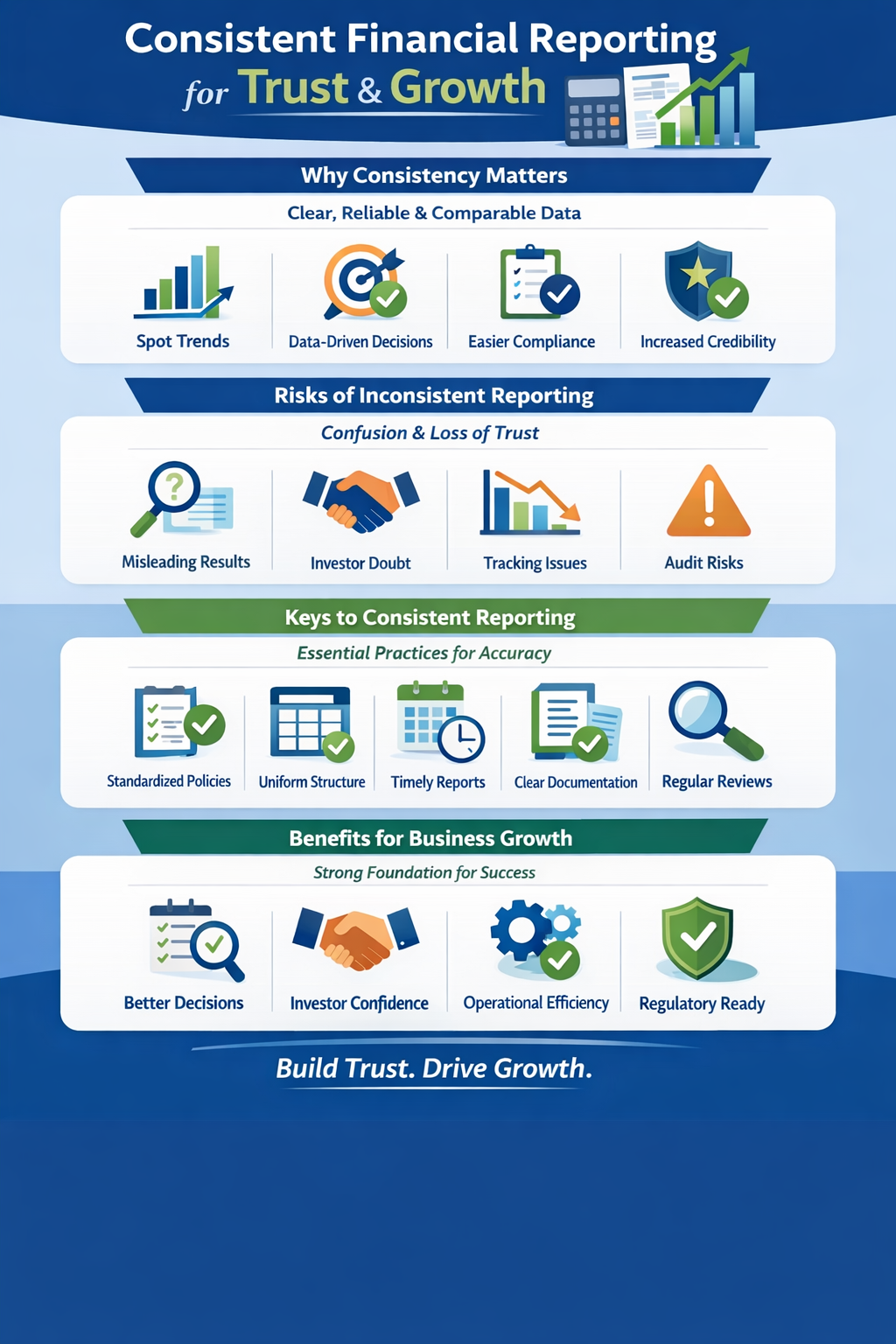
Consistency in financial reporting means presenting financial data using the same structure, accounting methods, and reporting timelines across different periods. When businesses maintain uniform reporting practices, it becomes easier for stakeholders—including investors, management teams, auditors, and regulators—to analyze financial performance accurately.
Consistent reporting allows organizations to compare results from one period to another without confusion. When the format, metrics, and accounting principles remain stable, financial data becomes easier to interpret and more reliable.
Businesses that prioritize consistency benefit in several ways. First, trends become clearer over time, allowing leaders to identify patterns in revenue, expenses, and profitability. Second, management teams can rely on accurate financial information when making strategic decisions. Third, compliance with regulatory standards becomes more straightforward because financial statements follow predictable structures. Finally, consistent reporting enhances credibility with investors, partners, and financial institutions.
In simple terms, consistent financial reporting transforms raw financial data into meaningful insights that guide business strategy.
When companies frequently change their reporting formats, accounting assumptions, or financial classifications, it creates unnecessary confusion. Even if the underlying business performance is strong, inconsistent reporting can make financial results appear unreliable or misleading.
One of the most common problems caused by inconsistent reporting is the misinterpretation of financial health. Investors and stakeholders may struggle to understand whether revenue is growing, expenses are increasing, or profits are declining because the presentation of financial information keeps changing.
Another significant issue is the loss of stakeholder trust. Investors expect transparency and reliability from businesses. If financial statements appear inconsistent or unclear, confidence in the organization may decrease.
Inconsistent reporting also makes it difficult for management teams to track progress or measure long-term performance accurately. Without standardized financial structures, comparing results from previous months or years becomes challenging.
Additionally, companies may face higher audit risks and compliance challenges when financial records are not consistently maintained. Auditors rely on clear and structured documentation to verify financial statements, and inconsistent reporting can complicate the auditing process.
To maintain consistency in financial reporting, organizations should focus on several essential elements that support clarity and reliability.
1.Standardized Accounting Policies
Businesses should follow consistent accounting principles when recording and reporting financial transactions. These policies should align with recognized accounting standards and remain stable across reporting periods.
If any changes to accounting policies become necessary, they should be carefully documented, justified, and clearly disclosed to stakeholders. Transparency helps maintain trust even when adjustments are required.
A consistent format for financial statements is essential for readability and comparison. Reports such as balance sheets, income statements, and cash flow statements should follow the same structure every time they are prepared.
Maintaining consistent headings, classifications, and data presentation allows readers to quickly locate the information they need and interpret it accurately.
Timely financial reporting ensures that decision-makers always have access to updated information, enabling them to respond quickly to changes in the business environment.
Financial reports often rely on estimates, assumptions, and calculation methods. These processes should be clearly documented and applied consistently across reporting periods.
Proper documentation ensures that financial data remains transparent and easy to verify during audits or internal reviews.
Consistent financial reporting is not just a compliance requirement—it is also a strategic advantage for growing businesses.
When financial data is reliable and easy to interpret, business leaders can make better decisions based on clear insights. Consistency allows companies to track revenue trends, control costs, and measure profitability more effectively.
Investor confidence also improves when businesses demonstrate transparent and organized financial reporting. Investors are more likely to support companies that maintain reliable financial records and provide consistent performance updates.
Operational efficiency is another major benefit. When financial reports follow standardized structures, teams spend less time correcting errors or reconciling inconsistent data. This allows finance professionals to focus on strategic planning and financial forecasting
Consistent reporting also prepares businesses for regulatory audits and compliance reviews. When financial documentation is organized and standardized, companies can respond quickly and confidently to regulatory requirements.
Overall, consistent financial reporting reflects professionalism, stability, and responsible financial management—qualities that contribute directly to long-term growth.
Organizations can adopt several practical strategies to maintain consistency in financial reporting.
Using reliable accounting software helps automate financial processes and ensures standardized data formatting. Modern financial tools reduce manual errors and improve data accuracy.
Training finance teams on reporting standards is equally important. Employees should clearly understand accounting policies, reporting structures, and documentation requirements.
Companies should also establish internal financial guidelines that outline reporting procedures and expectations. These guidelines serve as a reference point for finance teams and help maintain consistency across departments.
Regular review and verification of financial reports before publication can further prevent inconsistencies. A disciplined review process ensures that reports remain accurate and aligned with established standards.
Finally, if any changes to financial reporting practices are necessary, businesses should document and disclose those changes clearly to maintain transparency with stakeholders.
Consistent financial reporting is a fundamental pillar of trustworthy and successful businesses. It strengthens transparency, improves decision-making, and builds long-term confidence among investors, regulators, and management teams.
Businesses that treat financial reporting as a strategic asset rather than a routine obligation gain a competitive advantage. By maintaining standardized reporting structures, clear documentation, and reliable financial processes, organizations can transform financial data into valuable insights that guide growth.
Whether a company is a startup building its financial foundation or an established enterprise managing complex operations, consistent financial reporting plays a vital role in sustaining credibility and supporting long-term success.
Discover more insights about AI sales tools and analytics